
The Best Country to Retire to… Lies, damned lies, and statistics!


Last Updated on September 15, 2026
The saying is attributed to Mark Twain, but the truth is universal: numbers and reality aren’t always aligned. A case in point is the real living standards of citizens in first-world countries, which matters a great deal when you’re choosing where to retire.
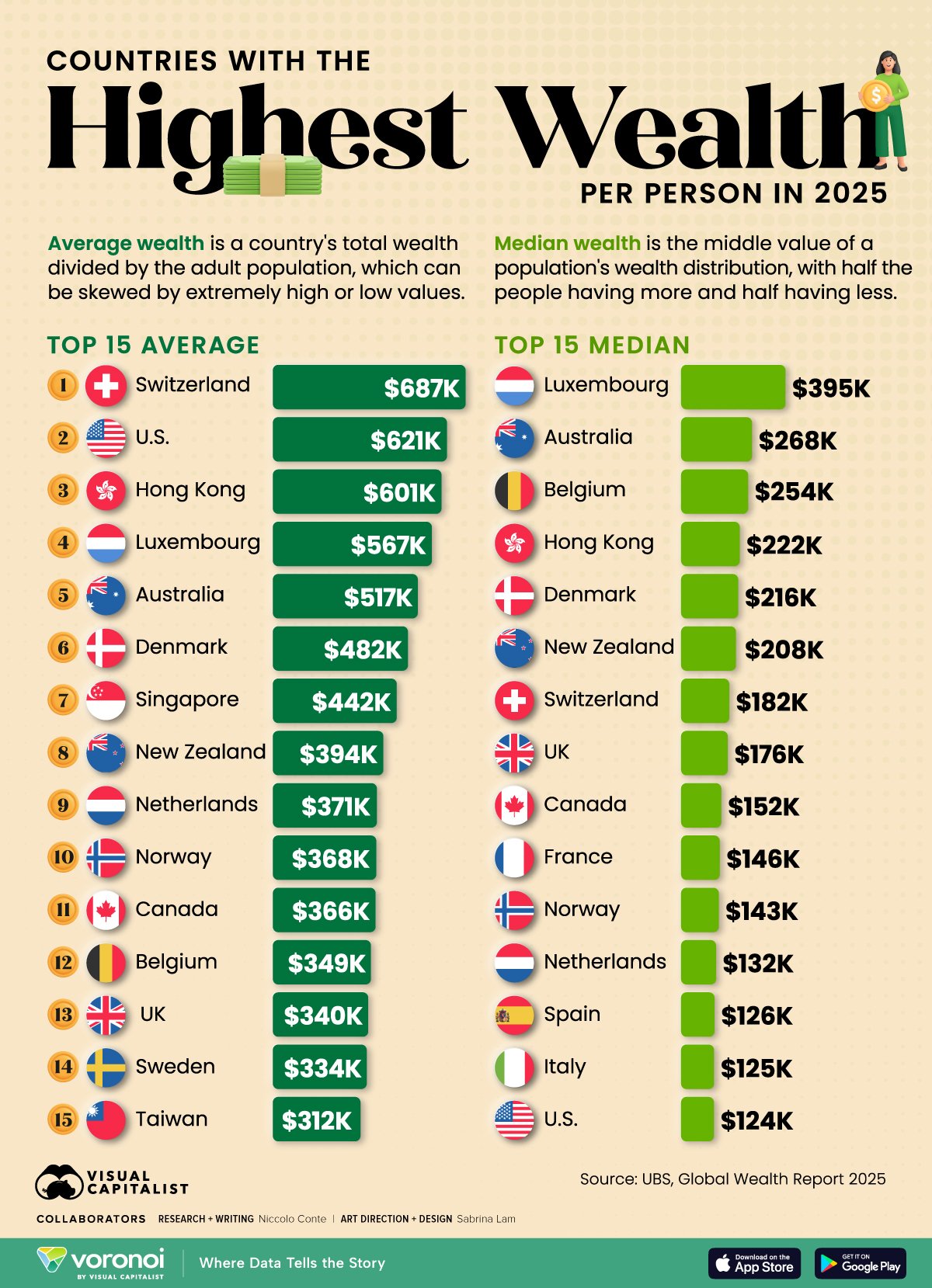
When retirees research international retirement destinations, they’re often drawn to countries with impressive “average wealth” statistics. The United States, for instance, boasts the second-highest average wealth per person globally at US$621,000, trailing only Switzerland at US$687,000. But here’s the uncomfortable truth: those eye-catching figures mask a reality that could derail your retirement plans faster than a market crash.
The great statistical deception: why average wealth misleads
Average wealth figures are essentially meaningless for retirement planning, because they’re heavily skewed by extreme inequality. Average wealth in the United States is US$621,000 per adult. Impressive! But recent Federal Reserve data shows the top 1% of Americans held 30.8% of total US net worth as of 2024.
The same data shows the top 10% owned almost two-thirds of total US wealth in early 2024. That leaves the vast majority of American adults, some 89%, sharing the remaining one-third.
Quite simply, averages create a statistical illusion. When a billionaire’s fortune gets averaged in with everyone else’s, it artificially inflates the mean. The result is a country that appears wealthy on paper while leaving many retirees financially vulnerable in reality.
Switzerland faces similar challenges. Its Gini coefficient of 0.33 (where 0 is perfect equality and higher numbers mean greater inequality) shows moderate but still significant wealth concentration. Topping average-wealth rankings doesn’t make it suitable for middle-class retirees.
The median truth: a better measure for real people
Median wealth tells a fundamentally different story. This metric represents what the typical citizen actually has: half the population owns more, half owns less. The differences are stark.
Top 10 countries by median wealth (2025):
- Luxembourg – $395,000
- Australia – $268,000
- Belgium – $254,000
- Hong Kong – $222,000
- Denmark – $216,000
- New Zealand – $208,000
- Switzerland – $182,000
- United Kingdom – $176,000
- Canada – $152,000
- France – $146,000
Notice how the United States, second in average wealth, plummets to 15th place in median wealth at just $124,000. That’s the actual financial reality for typical American retirees.
Australia: the hidden retirement gem
For most retirees with comfortable but not excessive savings, Australia emerges as a compelling choice. Here’s why.
Healthcare: the foundation of retirement security
In the US, a 65-year-old retiring today can expect to spend around US$165,000 on healthcare over retirement, with projections reaching US$320,000 for women because of longer life expectancy. Medicare Part B premiums alone cost US$185 a month in 2025, with high earners paying up to US$628.90.
Australia’s universal healthcare system is a stark contrast. Retirees receive comprehensive medical coverage through Medicare, with extra concessions available through the Pensioner Concession Card and the Commonwealth Seniors Health Card. The system covers bulk-billed GP visits, hospital care and subsidised medications, removing the primary financial stress that can upend American retirees.
The Age Pension safety net
Around 2.6 million Australians receive the Age Pension, roughly 39% on a full pension and 24% on a partial pension. Maximum rates (September 2025) are $1,178.70 per fortnight for singles (about $30,646 a year) and $1,777.00 per fortnight combined for couples (about $46,202 a year), a substantial foundation that keeps recipients well above poverty levels.
Importantly, the family home isn’t counted as an asset for pension means-testing, so retirees can keep their home while still qualifying. That’s a significant advantage over many other systems.
The superannuation advantage
Australia’s $3.7 trillion superannuation system has been called “the envy of the wealthy world” by financial leaders including BlackRock’s Larry Fink. For those 60 and older, super payments are typically tax-free, a significant advantage over traditional retirement accounts elsewhere.
Country by country: the top 10 by median wealth
1. Luxembourg ($395K)
Pros: topped the retirement-security health sub-index in 2024 on life expectancy; excellent infrastructure; central European location. Cons: extremely high cost of living; limited English-friendly healthcare; complex residency rules. Verdict: suitable only for the very wealthy.
2. Australia ($268K)
Pros: English-speaking, excellent healthcare, stable government, reasonable living costs outside the major cities, strong pension system. Cons: distance from Northern Hemisphere family; high property prices in Sydney and Melbourne. Verdict: ideal for most middle-class retirees.
3. Belgium ($254K)
Pros: central European location, good healthcare, moderate costs. Cons: complex tax system, language barriers, grey weather. Verdict: good for EU citizens, challenging for others.
4. Hong Kong ($222K)
Pros: no capital gains tax, excellent healthcare, cosmopolitan lifestyle. Cons: extremely high property costs, political uncertainty, air quality. Verdict: declining attractiveness.
5. Denmark ($216K)
Pros: top-10 globally for retirement security; excellent social services. Cons: very high taxes, expensive living, harsh winters. Verdict: great if you can carry the tax burden.
6. New Zealand ($208K)
Pros: English-speaking, beautiful environment, stable politics, reasonable healthcare. Cons: limited direct flights globally, expensive imports, earthquake risk. Verdict: excellent for peace and natural beauty.
7. Switzerland ($182K)
Pros: first place in retirement-security rankings with an 82% score; political stability; superb infrastructure. Cons: extremely high living costs, complex bureaucracy, language requirements. Verdict: only for the very wealthy, despite the median figure.
8. United Kingdom ($176K)
Pros: English-speaking, rich cultural amenities, good transport links. Cons: high taxes, variable healthcare quality, expensive housing. Verdict: familiar but expensive.
9. Canada ($152K)
Pros: English-speaking (mostly), excellent healthcare, cultural familiarity. Cons: harsh winters, high taxes, expensive major cities. Verdict: good for those wanting familiarity with better healthcare.
10. France ($146K)
Pros: excellent lifestyle, good healthcare, rich culture, mild southern climate. Cons: complex bureaucracy, language barriers, high taxes for residents. Verdict: attractive for those willing to navigate the system.
The American retirement reality check
Despite ranking second globally in average wealth, the US presents serious challenges for typical retirees:
Healthcare costs: averaging US$165,000 over retirement, these can devastate savings, with hospital deductibles and constantly rising premiums on top.
Wealth inequality: the top 1% earn about 40 times more than the bottom 90%, and roughly 33 million American workers earn under US$10 an hour.
Government debt: public debt across OECD countries has more than doubled this century, raising questions about future pension sustainability. It’s a concern everywhere, but US public debt is exceptionally high and accelerating.
Retirement security rankings tell the real story
Independent studies confirm that average wealth doesn’t translate into retirement security. The 2024 Natixis Global Retirement Index places Switzerland first, followed by Norway, Iceland and Ireland, with Luxembourg, the Netherlands and Australia all in the top seven. The US slipped from 16th in 2020 to 22nd in 2024.
The Mercer CFA Institute Global Pension Index gives A-grades only to the Netherlands, Iceland, Denmark and Israel, again leaving the US out of the top tier.
The bottom line
For retirees with comfortable but not exceptional savings, Australia offers an optimal combination: median wealth that reflects real affordability, universal healthcare removing the biggest retirement risk, an English-speaking environment with familiar legal systems, stable democratic government, a comprehensive pension safety net, and a top-seven global ranking for retirement security.
While the US dazzles with average-wealth statistics, its extreme inequality, healthcare costs and systemic risks make it suitable mainly for the genuinely wealthy. For everyone else, countries like Australia, focused on median prosperity and comprehensive safety nets, offer far more realistic paths to a secure and comfortable retirement.
The lesson is clear: when planning your retirement destination, ignore the statistical sizzle of average wealth and focus on the substance of median prosperity and support systems. Your future self will thank you for looking beyond the numbers to the reality beneath.
This article is general information, not financial or migration advice.